Business Loans for Bad Credit: What Actually Works in 2026
Business loans for bad credit (FICO 500–649) are real and accessible in 2026, but the products are different from prime-credit options. Approving products include merchant cash advances (FICO 500+), invoice factoring (530+), equipment financing (575+), revenue-based financing (580+), and secured lines of credit (600+). Trade-off: higher cost. Approval rates of 35–70% are typical depending on FICO bracket.

Business loans for bad credit (FICO 500–649) are real and accessible in 2026, but the products are different from prime-credit options. Approving products include merchant cash advances (FICO 500+), invoice factoring (530+), equipment financing (575+), revenue-based financing (580+), and secured lines of credit (600+). Trade-off: higher cost. Approval rates of 35–70% are typical depending on FICO bracket.
Key takeaways
- Bad credit (500–649 FICO) doesn't eliminate business loan options, it narrows them.
- Most accessible: MCA (FICO 500+), invoice factoring (530+), equipment financing (575+).
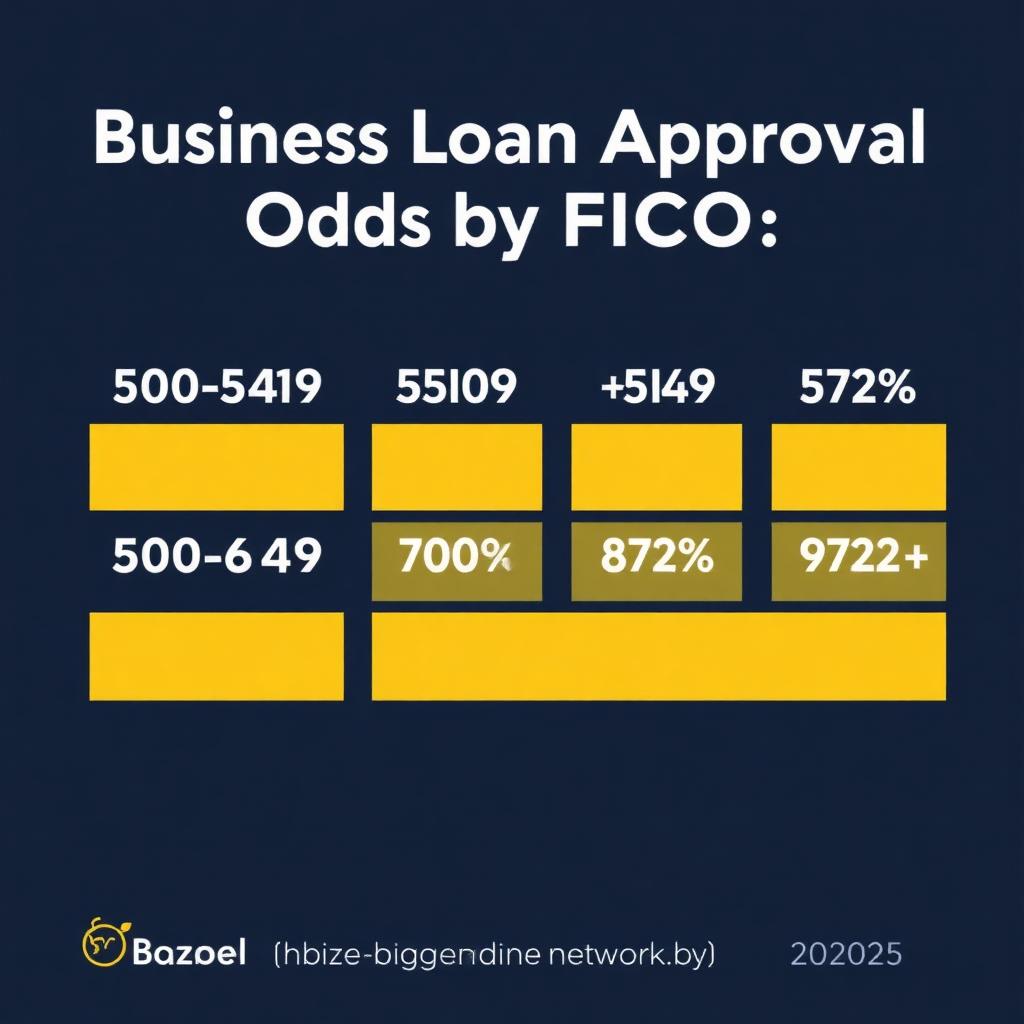
- Approval probability rises sharply with FICO bracket: 35% at 500–549, 70% at 600–649.
- Bad-credit products price higher: factor 1.30–1.50 for MCA, 14–35% APR for invoice factoring.
- Strong monthly revenue ($25K+) and time in business (24+ months) can offset lower FICO.
- Most decline reasons in this bracket: NSF history, undisclosed stacked debt, declining revenue trend.
- 60–90 day FICO cleanup before applying often unlocks substantially better pricing.
Who this is for
Small business owners researching business loans for bad credit who want a clear, advisor-quality overview before making a financing decision.
Operators comparing a current offer against alternative business loans for bad credit options to confirm they are getting market-competitive terms.
First-time borrowers who want to understand the full business loans for bad credit landscape before applying.
What you need to qualify
Typical requirements across the BizBee Funding partner network. Specific minimums vary by lender and product.
| Requirement | Typical standard |
|---|---|
| Personal FICO | 500+ (some MCA programs), 550+ (most), 600+ (broader product menu) |
| Time in business | 6+ months (12+ for better rates) |
| Monthly revenue | $10,000+ ($25K+ substantially improves options) |
| Bank statements | 3–6 months with ≤3 NSFs |
| No active bankruptcy or unresolved judgments | Required for most products |
| Existing advances | Disclosed upfront (lender will see them anyway) |
Best funding options
Product categories available through BizBee's lender network for this topic.
MCA
FICO 500+. Fastest funding. Factor 1.30–1.50.
Invoice Factoring
FICO 530+ (factoring underwrites your customer's credit, not yours).
Equipment Financing
FICO 575+. Asset secures the loan.
Revenue-Based Financing
FICO 580+. Payment flexes with revenue.
Secured Line of Credit
FICO 600+. Collateralized by AR or inventory.
How Lenders Underwrite Bad Credit Files in 2026
Bad credit in business lending typically means FICO 500–649. Below 500 is 'no credit / very poor' territory where most non-secured products won't approve. The 500–649 range is where alternative business products thrive: MCA, invoice factoring, equipment financing, revenue-based financing, and secured lines of credit. These lenders underwrite primarily on cash flow and asset security, not on FICO.
Approval probability rises sharply with FICO bracket. Based on BizBee Funding's lender network data: 500–549 FICO approves ~35% of clean files (no NSFs, $15K+/mo revenue, 12+ months in business). 550–599 approves ~55%. 600–649 approves ~70%. 650+ approves ~82%. 700+ approves ~92%. The single biggest probability-shift in the bracket is the 600 line — many programs that decline at 599 approve at 600.
Strong monthly revenue and time in business can substantially offset lower FICO. A 580 FICO with $80K/mo revenue and 4 years in business often qualifies for products that a 660 FICO with $12K/mo revenue and 8 months in business cannot. Lenders underwrite the full file, credit is one input, not the whole story.
The trade-off is pricing. Bad-credit-tier products price higher to compensate for elevated default risk: MCAs at factor 1.22–1.38 (roughly 30–55% APR equivalent), invoice factoring at 1–5% per 30-day period, equipment financing at 18–30% APR, revenue-based at 1.18–1.45 factor with revenue-flexible repayment, secured LOC at 14–28% on drawn balance.
The most common decline reasons in this bracket aren't FICO, they're NSFs (3+ in 90 days), undisclosed existing advances (lenders see them on bank statements and decline for misrepresentation), declining month-over-month revenue trend, and recent unresolved tax liens or judgments. The fix for most of these is 60–90 days of operational cleanup, which then often unlocks substantially better pricing.
BizBee Funding routinely works with bad-credit borrowers and places them across vetted lenders who specialize in this segment. The path is usually: prequalify (soft pull), get an initial offer, identify the gap between current offer and a much better offer at 30–60 points higher FICO, decide whether to fund now or pause briefly for cleanup. Many borrowers save tens of thousands by pausing 60 days.
What this typically costs
Representative 2026 cost scenarios. Your actual offer depends on credit, revenue, time in business, and lender.
| MCA (FICO 500–599) | Factor 1.25–1.40 · ≈35–60% APR |
| Invoice factoring (FICO 530+) | 1–5% per 30-day period · advance 80–95% of invoice |
| Equipment financing (FICO 575+) | 18–30% APR · 24–60 month term |
| Revenue-based (FICO 580+) | Factor 1.18–1.45 · 6–18 month effective term |
| Secured LOC (FICO 600+) | 14–28% APR on drawn balance |
| Same products at FICO 680+ | Often 30–60% cheaper across the board |
How to decide if this is right for you
Use this 5-step framework to narrow your shortlist before comparing specific offers.
-
1
Pull your actual FICO before applying
Many borrowers think their FICO is lower than it actually is. A current pull (Experian, MyFICO) often reveals you're in a better bracket than you assumed.
-
2
Count NSFs in the last 90 days
If >3, pause and clean up before applying. This single action often beats waiting for FICO to improve organically.
-
3
Match product to your actual file, not your wishful file
MCA, factoring, equipment, RBF, secured LOC, these are the bad-credit-tier products that approve.
-
4
Disclose existing advances upfront
Lenders see them on bank statements. Lying = immediate decline + future-application damage.
-
5
Plan the next 90 days to graduate to prime-tier products
Bad-credit products are a bridge, not a destination. Pay on time, build deposits, watch FICO climb, refinance into cheaper products.
When this makes sense
- Your FICO is 500–649 and you need funding within 1–7 days.
- Your monthly revenue and time in business compensate for the FICO score.
- You've already cleaned up NSFs and existing advances are disclosed.
- The cost of the bad-credit product is still positive on a unit-economics basis for the use of funds.
- You have a 60–90 day plan to clean up credit before the next financing round.
When to be careful
- When the use of funds doesn't generate enough return to cover bad-credit-tier pricing.
- When you're about to stack onto existing advances (decline + reputational damage).
- When the lender refuses to disclose APR or total payback (sign of predatory operator).
- When you could wait 60–90 days for FICO cleanup and unlock 30–60% cheaper pricing.
- When the contract includes a confession-of-judgment clause.
How this plays out in practice
Bad credit, strong revenue — placed cleanly
Situation: Trucking owner-operator with 575 FICO, 3 years in business, $42K/mo revenue. Needed $35K to repair a downed truck.
Recommendation: Placed an equipment-secured term loan at 19.5% APR over 36 months. Monthly payment $1,290. The repaired truck generated $8K/month, paid back in 4–5 months on contribution basis.
The cleanup that saved $14,000
Situation: Owner applied with 565 FICO, 4 NSFs in last 90 days. Initial offer: $40K at 1.45 factor / 7 months / $58K total payback.
Recommendation: We paused 75 days, cleaned up NSFs, FICO climbed to 615. Re-applied, placed at 1.24 factor / 10 months / $49,600 total payback. Same lender, saved $14,400 in 75 days.
When bad credit means using factoring instead
Situation: Marketing agency had 540 FICO but $180K in unpaid B2B invoices to creditworthy enterprise clients.
Recommendation: Routed to invoice factoring, advanced 85% of invoices at 2.5% per 30-day period. Same-day funding, no debt added. FICO of the agency owner didn't matter, the invoice payers' credit drove the deal.
Bad credit doesn't mean no funding
Soft-pull prequalification across MCA, factoring, equipment, and revenue-based lenders that specialize in 500–649 FICO files. Compare real offers in 24 hours.
Frequently asked
Common questions
Key facts in one line
- Business loans for bad credit (FICO 500–649) are accessible — through MCA, factoring, equipment, RBF, and secured LOC products.
- Approval probability rises sharply with FICO: ~35% at 500–549, ~70% at 600–649, ~92% at 700+.
- Strong revenue and time in business substantially offset lower FICO in alternative-product underwriting.
- 60–90 day cleanup of NSFs and FICO often unlocks 30–60% cheaper pricing.
- Bad-credit products are a bridge, not a destination, most borrowers graduate to prime-tier within 12–24 months.
Glossary
Terms worth knowing
- Factor rate
- A multiplier (e.g., 1.40) applied to the funded amount to calculate total payback. Common in MCA and short-term working-capital products.
- Stacking
- Taking on a second advance while a first is still outstanding. Most reputable lenders decline stacking files; some allow it via consolidation.
- Soft pull
- A credit inquiry that doesn't affect your FICO. Used for prequalification, the standard at any reputable lender.
Ready to Join the Hive?
Apply now via BeeLine™ and get your funding decision in minutes. Complete in less than 60 seconds.