Business Loans Without a Personal Guarantee
Most small-business loans require a personal guarantee. No-PG options: corporate cards, equipment financing (asset-secured), non-recourse factoring, and bank LOCs for established businesses with $1M+ revenue.

True no-personal-guarantee business loans are rare and typically reserved for established businesses ($1M+ annual revenue, 2+ years operating, strong business credit). The main no-PG options are corporate credit cards, asset-secured equipment financing, invoice factoring (non-recourse), and some large bank LOCs. Most small-business loans under $250K require a personal guarantee from majority owners.
Key takeaways
- Most loans under $250K require a personal guarantee.
- Equipment financing is the easiest no-PG option (asset-secured).
- Non-recourse invoice factoring shifts collection risk to the funder.
- Corporate credit cards (Brex, Ramp) don't require a PG for qualifying businesses.
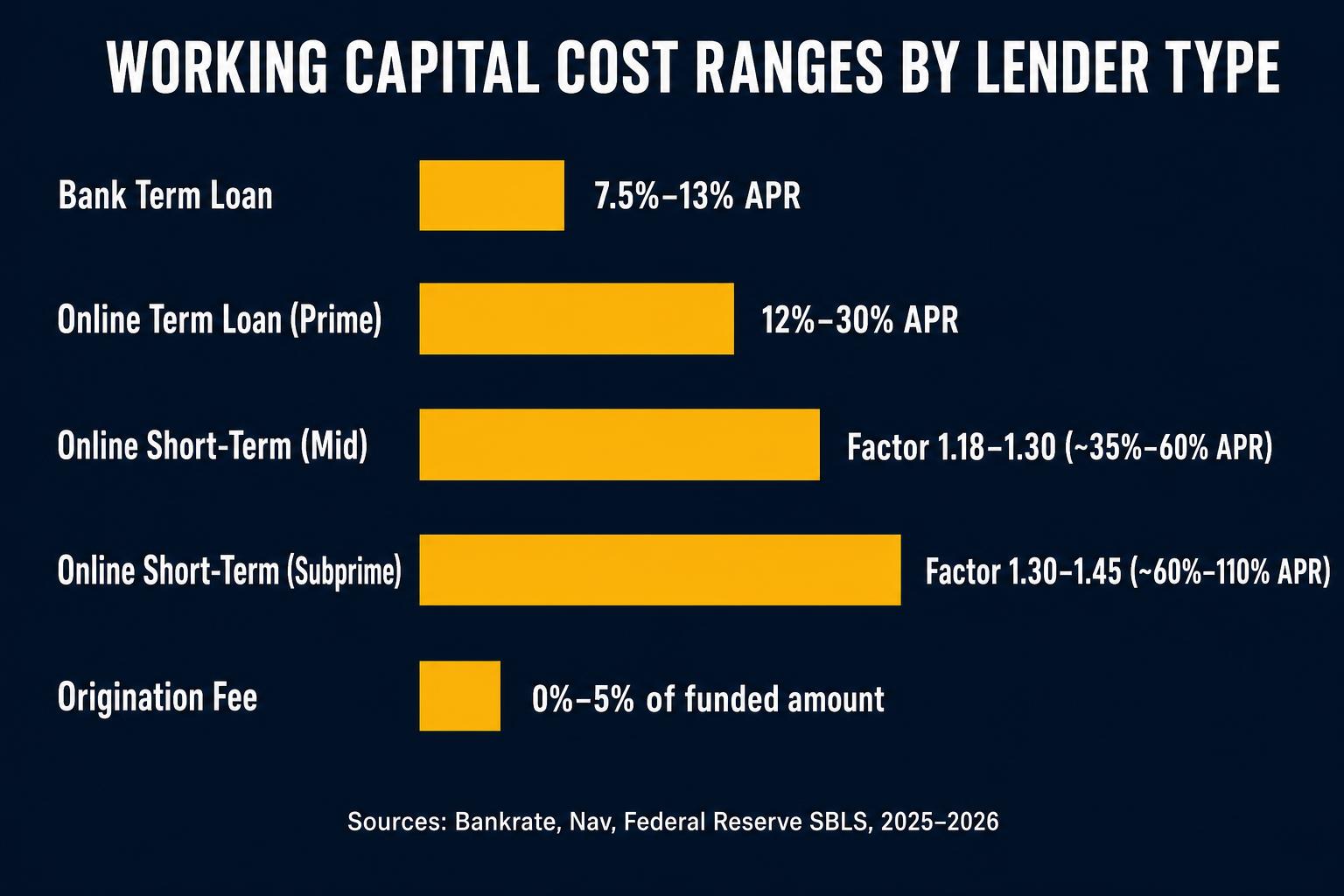
- No-PG loans typically cost 2%–10% more APR than guaranteed versions.
Who this is for
Established businesses trying to protect personal assets from business debt.
What you need to qualify
| Requirement | Typical standard |
|---|---|
| Equipment financing (no PG) | $500K+ annual revenue, asset as collateral |
| Non-recourse factoring | Creditworthy customers, $30K+/mo invoices |
| Corporate cards (no PG) | $50K+ in business bank balance, established entity |
| Bank no-PG LOC | $1M+ revenue, 2+ yrs, strong business credit |
Why most small-business loans require a personal guarantee
A personal guarantee (PG) is a separate contract where the business owner agrees to be personally liable for the business debt if the business defaults. It pierces the LLC or corporation for that specific debt. Lenders require it on most small-business loans because most small businesses don't have enough business credit, assets, or operating history to secure the loan on the business entity alone.
For loans under $250K, a PG is essentially universal. SBA explicitly requires a PG from any owner with 20%+ stake. Banks and online lenders almost always require one. Removing the PG is typically only possible at $250K+ loan sizes with established businesses ($1M+ revenue, 2+ years, strong business credit), and usually at a higher rate or with additional collateral.
The four products that genuinely offer no-PG paths
Corporate credit cards (Brex, Ramp, Mercury), designed for funded startups and established businesses with $50K+ in business bank balance. No PG, but underwritten on entity creditworthiness. Equipment financing, the asset secures the deal, so the PG is often waivable on larger deals ($100K+) with strong business cash flow. Non-recourse invoice factoring — the factor absorbs the credit loss if the customer doesn't pay; PG-free, but priced 1%–2% higher than recourse factoring. Large bank LOCs ($500K+) at $1M+ revenue businesses with established business credit, these are negotiable but rare for sub-$1M companies.
Trade-offs of going no-PG
No-PG products typically cost 2%–10% more APR than their PG-required equivalents, have lower limits (usually $50K–$250K vs $500K+), and require stronger entity credit. The right question isn't 'how do I avoid a PG', it's 'is the asset protection worth the higher cost and smaller loan size?'
For most owners, the answer is no until business net worth and personal exposure are large enough to justify the spread. A $100K loan at 25% APR with a PG often beats a $50K loan at 30% APR without one when the use of funds is the same.
What a personal guarantee actually exposes, and what it doesn't
A standard PG makes the owner personally liable for the unpaid business debt if the business defaults, meaning the lender can sue the owner personally, win a judgment, and collect against personal bank accounts, wages, and (in most states) non-homestead assets. Homestead protection laws in Florida, Texas, Iowa, and a handful of other states shield primary residences from most business-debt judgments; in non-homestead states, home equity is exposed up to the state's exemption limit.
What a standard PG does not do: it does not automatically jeopardize a spouse's separate property unless the spouse co-signed, and it does not survive bankruptcy in most cases — personal Chapter 7 typically discharges PG liability on uncollateralized business debt. The practical worst case is therefore an owner with significant non-exempt personal assets in a non-homestead state, no spouse-separate-property protection, and a business in a volatile industry. Owners outside that worst-case profile usually find the asset-protection benefit of avoiding a PG smaller than they assume.
Trade-off math worth running: a 5-point APR premium on a $200K, 36-month loan costs roughly $15K extra over the life of the loan. If personal asset exposure under a PG is under $50K (after homestead and exemption protection), the no-PG premium is rarely worth it. Above $250K of exposed assets, the calculus often flips and no-PG products become economically defensible, particularly equipment financing structured as entity-only obligation with the asset providing full collateral coverage.
How to negotiate a PG removal or limited PG
Full PG removal is rare on loans under $250K but becomes negotiable above that size, particularly when the borrower brings competing offers or pledges additional collateral. The more common middle ground is a 'limited PG' that caps personal liability at a specific dollar amount (often 50%–100% of principal), expires after a payment-history milestone (typically 12–24 months on-time), or releases on a specific loan-to-revenue threshold being maintained for two consecutive quarters.
Practical negotiation levers: (1) competing offers, banks consistently move on PG terms when shown a competing offer with weaker terms; (2) additional collateral, pledging specific equipment, AR, or a CD as supplemental security often unlocks limited-PG structures; (3) covenant trade, agreeing to financial covenants (minimum DSCR, debt-to-equity caps, no additional debt without consent) frequently substitutes for full personal recourse on bank loans above $500K. SBA loans remain the exception — SBA explicitly requires unlimited PG from any 20%+ owner, and that requirement is non-negotiable.
How non-recourse factoring and entity-only equipment financing actually work
Non-recourse invoice factoring shifts customer credit risk to the factor: if the customer doesn't pay within an agreed window (typically 90 days), the factor absorbs the loss rather than charging the borrower back. The trade-off is selectivity, non-recourse factors will only buy invoices from customers with strong credit ratings, typically Dun & Bradstreet PAYDEX scores above 70 or comparable commercial credit profiles. Customers that fail the credit check still get factored on a recourse basis or are excluded entirely. Pricing for non-recourse runs 1%–2% higher per 30 days than recourse factoring (typical: 3%–5% per 30 days vs 2%–3.5% recourse). For B2B businesses with concentrated customer risk, one or two large customers representing 40%+ of revenue, non-recourse converts the worst-case loss from 'business-ending' to 'fee already paid.'
Entity-only equipment financing works on the same secured-asset principle. The lender takes a UCC-1 filing on the specific equipment as primary collateral, perfects its security interest, and prices the deal based on equipment value, useful life, and resale market. On deals above $100K with business cash flow strong enough to support DSCR of 1.25+, the PG is genuinely waivable, the asset coverage is enough. Practical screen: look for equipment with active secondary markets (commercial trucks, CNC machines, restaurant equipment from major OEMs) and avoid highly specialized or rapidly depreciating assets where the lender can't recover meaningful value at resale. Software and intangibles almost never qualify for no-PG entity financing because there's nothing to repossess.
Both structures share the same underlying lesson: lenders waive personal recourse when something else (a creditworthy customer, a marketable asset, an established business entity) can absorb the credit risk. Identify what your business already has that could substitute for personal liability — strong customer concentration, owned equipment, AR balance, and you've identified your most viable no-PG path.
How to decide if this is right for you
Five questions decide whether a no-PG product fits.
-
1
Is your business at $1M+ revenue with 2+ years operating?
Below this, true no-PG bank LOCs are essentially unavailable. Focus on equipment, factoring, or corporate cards instead.
-
2
Do you have a specific asset to pledge?
Equipment or AR can secure the deal in place of a PG. Without one, no-PG access narrows sharply.
-
3
Can you absorb the 2%–10% APR premium?
No-PG products cost more. Run the math against PG-required alternatives at the same loan size.
-
4
Is the loan size small enough for a corporate card?
Brex/Ramp can cover $25K–$100K of monthly spend with no PG for qualifying entities, often the simplest no-PG path.
-
5
Are you protecting against business-specific risk?
If the worry is industry volatility, no-PG products plus an LLC structure are the cleanest protection. If the worry is general liability, insurance is usually cheaper than no-PG premium.
When this makes sense
- You're at $1M+ revenue with established business credit.
- You have a specific asset or receivable that can secure the deal.
When to be careful
- Marketing claims of 'no PG for any size', almost always a bait-and-switch.
- Trade-off: no-PG products usually cost more and have lower limits.
How this plays out in practice
Established business protecting personal assets
Situation: $2.5M revenue HVAC contractor, 6 years in business, 720 FICO, $400K equipment-funded need. Owner wants no PG to insulate personal home equity.
Recommendation: Equipment financing structured with the equipment as full collateral and entity-only obligation. Bank may waive PG given asset coverage and business strength.
Startup founder offered Brex card vs PG term loan
Situation: Funded SaaS startup, $50K business balance, $30K/mo software spend, needs the equivalent of $50K in working credit.
Recommendation: Corporate card. No PG, no application fees, and the spend volume earns rewards. Better fit than a PG-required term loan for ongoing operating expenses.
Owner pushed toward 'no-PG' product that's actually PG
Situation: Owner offered an MCA marketed as 'no personal guarantee,' but the contract includes a Confession of Judgment and personal liability under default.
Recommendation: Read the contract. Many 'no-PG' marketing claims are misleading. A true no-PG contract has zero personal recourse, no COJ, no personal liability clause.
Multi-owner LLC negotiating split PGs
Situation: Two equal partners in a $1.4M services LLC, 5 years operating, applying for a $300K bank term loan. One partner has $800K personal net worth; the other has $40K and concerns about exposure.
Recommendation: Negotiate split personal guarantees proportional to ownership (50/50) with a limited-PG cap on each at $150K, total personal exposure equals principal, but neither partner is on the hook for the full debt. Banks accept this structure routinely above $250K when the business cash flow comfortably covers DSCR. Document the split in the loan agreement, not just a side letter.
Find a no-PG path that fits
BizBee advisors know which lenders genuinely offer no-PG products for your profile.
Frequently asked
Common questions
Glossary
Terms worth knowing
- Personal guarantee (PG)
- A separate contract where an owner is personally liable for business debt if the business defaults. Pierces the LLC for that debt.
- Non-recourse factoring
- A factoring agreement where the factor absorbs credit losses from customer non-payment. Typically priced 1%–2% above recourse factoring.
- Confession of Judgment (COJ)
- A clause some lenders include allowing them to obtain a court judgment without trial in certain states on default. Even 'no-PG' contracts with a COJ create personal exposure.
- Corporate card
- A credit card issued to the business entity with no owner personal guarantee. Limits set by business bank balance and entity creditworthiness.
- Limited personal guarantee
- A PG capped at a specific dollar amount, percentage of principal, or duration. Common middle ground when full PG removal isn't possible — caps the owner's personal exposure while still giving the lender recourse.
- Burn-off PG
- A personal guarantee that automatically releases after the borrower meets a performance milestone (typically 24 months of on-time payments or a debt-to-revenue ratio held below a set threshold for 4 consecutive quarters). Negotiable on bank loans above $500K.
Ready to Join the Hive?
Apply now via BeeLine™ and get your funding decision in minutes. Complete in less than 60 seconds.