Business Revenue and Online Loan Eligibility: 2026 Thresholds
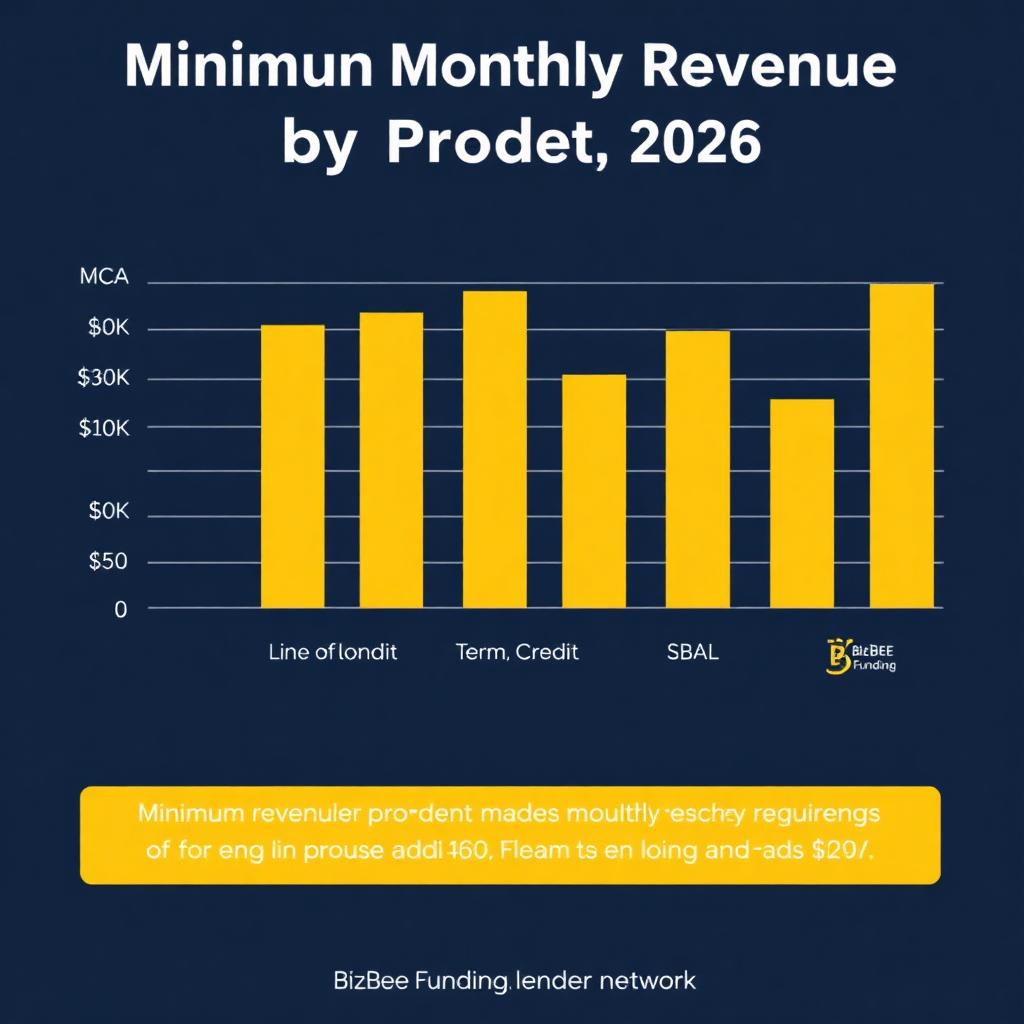
Most online business loan programs in 2026 require $10,000+ in monthly business deposits to qualify. MCA and revenue-based products start as low as $8,000/mo; bank-fintech term loans typically require $25,000+/mo. The lender also analyzes deposit consistency, NSF history, average daily balance, and seasonality, not just the headline number.

Most online business loan programs in 2026 require $10,000+ in monthly business deposits to qualify. MCA and revenue-based products start as low as $8,000/mo; bank-fintech term loans typically require $25,000+/mo. The lender also analyzes deposit consistency, NSF history, average daily balance, and seasonality, not just the headline number.
Key takeaways
- Online business loan minimum: typically $10,000/month in deposits.
- MCA / revenue-based: starts as low as $8,000/month.
- Bank-fintech term loans: typically $25,000/month minimum.
- Lenders care about deposit consistency, NSFs, and average daily balance, not just totals.
- Approved loan amount commonly caps at roughly 1x monthly revenue for unsecured short-term offers.
- Seasonal businesses are evaluated on trailing-12 average, not last month.
- Stacking existing advances disqualifies you from many programs — disclose upfront.
Who this is for
Small business owners researching business revenue online loan eligibility who want a clear, advisor-quality overview before making a financing decision.
Operators comparing a current offer against alternative business revenue online loan eligibility options to confirm they are getting market-competitive terms.
First-time borrowers who want to understand the full business revenue online loan eligibility landscape before applying.
What you need to qualify
Typical requirements across the BizBee Funding partner network. Specific minimums vary by lender and product.
| Requirement | Typical standard |
|---|---|
| Working capital / LOC (online) | $10,000+/month in deposits |
| MCA / revenue-based | $8,000+/month |
| Equipment financing (online) | $10,000+/month |
| Bank-fintech term loan | $25,000+/month |
| SBA online | $30,000+/month and 2+ years in business |
| Average daily balance | Min ~$1,000; ideally 1x daily expected debit |
| NSFs (3 months) | ≤3, none in most recent month preferred |
Best funding options
Product categories available through BizBee's lender network for this topic.
Working Capital Loan
Most flexible revenue threshold ($10K+/mo).
MCA
Lowest revenue minimum ($8K+/mo) but highest cost.
Revenue-Based Financing
Payments flex with deposit volume.
Business Line of Credit
Requires consistent monthly deposit pattern.
Equipment Financing
Asset secures the loan, slightly lower revenue tolerance.
What Lenders Actually See When They Read Your Bank Statements
Lenders don't underwrite the dollar number on your application, they underwrite the bank statements you upload. A modern online underwriting model reads 3–6 months of statements and extracts seven metrics: total deposit volume, deposit count (number of distinct deposits per month), average daily balance, ending balance, NSF/overdraft count, existing MCA debits, and seasonality variance. Your 'monthly revenue' field is a sanity check against the statement-derived number, and statements always win when they conflict.
Deposit volume is the headline. Most online lenders require $10K+ in monthly business deposits to consider a working-capital or LOC offer. MCA and revenue-based programs sometimes start at $8K. Bank-fintech partners typically require $25K+. SBA online platforms generally require $30K+ and 2+ years in business.
Deposit consistency matters as much as total. A business that deposits $40K in one lump and nothing else for 25 days underwrites differently than a business that deposits $1,500–$2,000 per business day. Frequent, smaller deposits demonstrate stable cash flow and improve approval odds.
NSFs and overdrafts are deal-killers. More than 3 NSFs across the most recent 3 months will decline most programs. The fix isn't complicated, it just takes 60–90 days. Avoid all overdrafts, keep a $1K+ minimum balance, and stop running personal expenses through the business account.
Average daily balance is the cushion check. Most lenders want to see an ADB at least equal to your daily expected ACH debit. If your offered loan would debit $250/day and your ADB is $180, expect a smaller offer or a decline. Building ADB by leaving a working buffer in the account is the cheapest 'rate improvement' available to most owners.
Existing MCA debits trigger automatic stacking review. If your statements show daily ACH debits from another funder you didn't disclose, most lenders decline immediately for misrepresentation. Always disclose existing advances upfront — most programs allow one existing position with the right consolidation plan.
Plaid, Bank-Statement OCR, and the 2026 Underwriting Stack
Online lenders in 2026 rarely re-key your statements by hand. The dominant ingest path is Plaid (or MX/Finicity) instant bank verification, which returns 24 months of transaction-level data, identity confirmation, and current balances within seconds. If you decline Plaid, lenders fall back to PDF OCR, which works but adds 24–48 hours and triggers more manual review. Connecting Plaid almost always produces a faster, larger offer because underwriting can see ADB volatility, payroll cadence, and merchant-processor deposits at the transaction level.
The 2026 underwriting stack scores seven signals on a weighted basis. Deposit volume (~30%), deposit count and cadence (~15%), average daily balance vs. proposed debit (~15%), NSF/overdraft frequency (~15%), trend slope month-over-month (~10%), concentration risk (~10%), and existing-position stacking (~5%). A weak score on any single signal can be offset by strength elsewhere, but two reds typically force a decline or a 30–50% offer haircut.
Trend slope is the most under-discussed factor. A business with $25K/mo flat for 12 months scores higher than a business that ran $40K → $28K → $22K over the last three months even though the second business has higher 'average' revenue. Lenders weight the most recent 60 days at roughly 2x the older 60 days. If you're applying after a soft quarter, wait one cycle and let the trend stabilize, or be ready to attach a written explanation tied to seasonality or a one-time event.
What this typically costs
Representative 2026 cost scenarios. Your actual offer depends on credit, revenue, time in business, and lender.
| $8K–$15K/mo revenue | MCA/RBF only · factor 1.30–1.50 |
| $15K–$30K/mo | Working capital + LOC · factor 1.22–1.40 or 14–35% APR |
| $30K–$75K/mo | Bank-fintech term loan eligible · 10–24% APR |
| $75K+/mo | Full product menu including SBA online · 8–18% APR |
| Loan-to-revenue cap (unsecured) | Typically 1x monthly revenue |
How to decide if this is right for you
Use this 5-step framework to narrow your shortlist before comparing specific offers.
-
1
Pull your last 3 months of statements
Sum deposits. That number, not your bookkeeping P&L, drives online eligibility.
-
2
Count NSFs in the last 90 days
If >3, pause and clean up before applying. Otherwise expect declines or reduced offers.
-
3
Calculate your average daily balance
Sum end-of-day balances ÷ days in the period. Match against proposed daily debit.
-
4
Identify any concentration above 25%
Single-customer >25% triggers risk-adjusted offers. Plan ahead with explanation.
-
5
Disclose existing advances upfront
Misrepresentation = immediate decline + future-application damage. Honesty wins.
When this makes sense
- Your trailing-3-month deposits are consistently above the product threshold.
- You have fewer than 3 NSFs across the last 90 days.
- Your average daily balance is at least 1x the proposed daily debit.
- You can disclose any existing advances honestly upfront.
- Your seasonality variance is captured by trailing-12 averaging, not just last month.
When to be careful
- When you're inflating revenue on the application — statements always win.
- When you have a high deposit volume but most of it is from inter-account transfers.
- When existing MCA debits are present but not disclosed.
- When most deposits are from a single concentrated customer (concentration risk).
- When your last month is well below your trailing-12 average (lenders flag declining trend).
How this plays out in practice
The seasonal landscaper underwritten correctly
Situation: Landscaper deposits $80K/mo April–October and $5K/mo November–March. Applied in February.
Recommendation: Used trailing-12 average ($48K/mo) instead of last month. Approved for $50K LOC at 15.5% APR with seasonal-flex draw schedule. A lender that underwrote only on last month would have declined.
Concentration risk caught early
Situation: An IT consulting firm had $35K/mo revenue but 78% came from a single client.
Recommendation: Approved at a reduced amount ($25K vs. requested $50K) due to concentration risk. Suggested diversifying revenue and re-applying in 6 months for the full amount.
The NSF cleanup that doubled the offer
Situation: Restaurant had 7 NSFs in the most recent 90 days, declined by 4 lenders.
Recommendation: Paused 90 days, cleaned up overdraft pattern, re-applied. Same lenders that declined approved at $60K (vs. requested $30K previously). The cleanup paid for itself many times over.
Plaid connection turned a decline into a $75K LOC
Situation: A specialty retailer initially submitted PDF statements; OCR misread a transfer as a debit and triggered a stacking flag, leading to decline.
Recommendation: Re-applied via Plaid instant verification. Transaction-level data showed the 'debit' was an inter-account transfer, ADB cleared at $4,200, and approval came through at $75K LOC, 17.9% APR, 24-month draw period.
Find out exactly what you qualify for
Soft-pull prequalification reads your real bank-statement profile, not just your application form. See your actual offers in under 24 hours.
Frequently asked
Common questions
Key facts in one line
- Most online business loans require $10,000+ in monthly business deposits to qualify.
- Bank statements override application-form revenue claims in every modern underwriting model.
- More than 3 NSFs in 90 days disqualifies most online loan programs.
- Unsecured online offers typically cap at roughly 1x monthly revenue.
- Seasonal businesses should be underwritten on trailing-12 averages, not last month.
Glossary
Terms worth knowing
- Average daily balance (ADB)
- The sum of end-of-day balances divided by the number of days in the period.
- NSF
- Non-sufficient funds, a returned debit, usually flagged on bank statements as a deal-killer in lender underwriting.
- Concentration risk
- When a high share of revenue comes from a single customer or contract, typically flagged above 25%.
- Stacking
- Taking on multiple short-term advances simultaneously. Most online lenders refuse to fund into a stacked position without consolidation.
- Trend slope
- The month-over-month change in deposit volume across the trailing 6 months; declining slopes typically reduce offer size 20–40%.
- Plaid IBV
- Instant Bank Verification, read-only Plaid connection returning 24 months of transaction-level data to underwriting in seconds.
Ready to Join the Hive?
Apply now via BeeLine™ and get your funding decision in minutes. Complete in less than 60 seconds.