How to Find Reputable Lenders for Your Business Loan
Reputable lenders for a business loan never charge upfront fees, disclose the full dollar cost in writing, are properly licensed in your state, and consistently show up in independent reviews (Trustpilot, BBB, NerdWallet, Nav, Bankrate). Start with established direct lenders or a transparent broker that uses a soft credit pull and shows you multiple offers side by side.

To find reputable lenders for a business loan, start by checking three independent signals: licensing (the lender is registered in your state where required), independent reviews (200+ reviews on Trustpilot, BBB rating, presence on NerdWallet/Nav/Bankrate review pages), and fee transparency (no upfront fees, full dollar cost disclosed in writing, contract sent for review before signing). Then verify three operational behaviors: they use a soft credit pull for prequalification, they explain factor rates and APRs in plain English, and they do not pressure you to sign within hours. A reputable broker — one paid by the lender at closing, not by you up front, can short-circuit this work by submitting your single application to multiple pre-vetted partners. BizBee Funding maintains a network of 100+ lenders that have passed our review on these exact criteria.
Key takeaways
- Reputable lenders never charge upfront fees, this is the single clearest red flag per NerdWallet, Nav, and Finder.
- Verify licensing, independent reviews (Trustpilot, BBB, third-party comparison sites), and fee disclosure in writing.
- A legitimate broker is paid by the lender at closing, not by the borrower up front.
- Soft credit pull for prequalification is a baseline behavior of any modern reputable lender.
- Pressure to sign within hours, vague factor rates, and confession-of-judgment clauses are non-starters.
- Comparing 2–3 offers, ideally across product types, reveals predatory pricing immediately.
Who this is for
First-time borrowers who have been cold-called by a lender or broker and want to verify whether the offer is legitimate before signing.
Owners who have applied to a marketplace and received aggressive follow-up calls from multiple unfamiliar names and want to know which to trust.
Established businesses comparing direct lenders, marketplaces, and brokers and trying to understand the trade-offs of each.
What you need to qualify
Reputable-lender baseline behaviors. Treat any deviation from these as a yellow flag worth questioning.
| Requirement | Typical standard |
|---|---|
| State licensing | Properly licensed in your state where required (commercial lending varies by state) |
| Independent reviews | Visible on Trustpilot, BBB, NerdWallet, Nav, or Bankrate with 100+ third-party reviews |
| Upfront fees | Zero. Legitimate fees are paid at closing or built into the loan price |
| Soft credit pull | Used for prequalification; hard pull only after offer acceptance |
| Fee disclosure | Total dollar cost, payment schedule, and effective APR provided in writing before signing |
| Contract | Sent for review at least 24 hours before signing in most reputable scenarios |
| Communication | Reachable phone, US-based support, named representative on the file |
Best funding options
There are three channels for sourcing a business loan, each with trade-offs. Reputable players exist in all three.
Direct lenders
You apply directly to the funder (bank, online lender, SBA preferred lender). Best when you already know exactly which product and provider you want.
Marketplaces / aggregators
You submit one application and the marketplace sells your lead to multiple lenders. Convenient but can result in heavy follow-up calls from many unknown names.
Brokers / advisors (like BizBee)
A single point of contact submits your application to a vetted network and brings back filtered offers. The broker is paid by the lender at closing.
Vetted-lender authority guide
Read how BizBee evaluates and onboards lender partners — licensing, complaint history, contract review, pricing transparency.
Questions to ask a lender
The 12-question checklist we walk every client through before signing, covers cost, structure, defaults, and prepayment.
The 7 Signals of a Reputable Business Lender, and the 7 Signals of a Predatory One
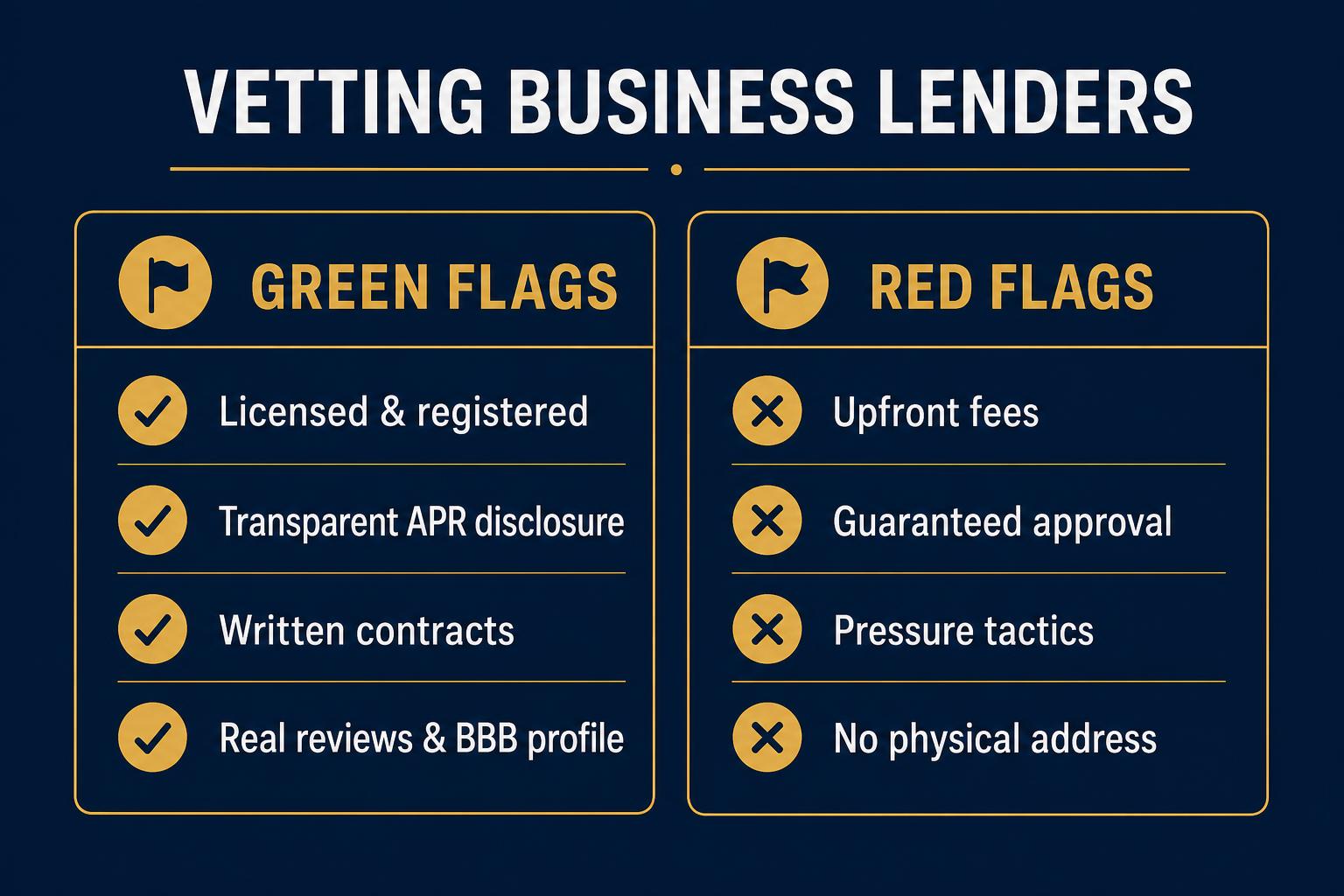
After reviewing thousands of business loan offers across our network, the patterns separating reputable lenders from predatory operators are remarkably consistent. The seven reliable signs of a reputable lender are: (1) verifiable state licensing where required; (2) consistent independent reviews on Trustpilot, BBB, and third-party comparison sites with at least a year of history; (3) zero upfront fees of any kind; (4) a soft credit pull used for prequalification, with a hard pull only after the borrower accepts a specific offer; (5) full dollar-cost disclosure in writing, meaning the total payback, the payment schedule, and the effective APR or factor rate shown plainly; (6) a contract sent for review at least 24 hours before signing in most cases; and (7) a named human representative who answers the phone at a U.S. business number.
The seven signs of a predatory lender mirror these in reverse: (1) upfront fees disguised as 'processing,' 'application,' 'origination paid before closing,' or 'underwriting deposits'; (2) refusal to disclose the funder's name (legitimate lenders do not hide who is actually lending the money); (3) pressure to sign within hours, often paired with a 'this rate expires today' urgency tactic; (4) factor rates without APR conversion; (5) confession-of-judgment clauses still appearing in some non-New-York jurisdictions, allowing the lender to obtain a judgment without notice on a missed payment; (6) hard credit pulls run before you have agreed to any specific offer; and (7) no findable web presence, no licensed broker disclosure, and no clear physical address.
The single most reliable filter, and the one we apply at BizBee before adding any lender to the network — is whether the lender will send a complete written term sheet showing the total dollar cost, the payment schedule, and any prepayment penalties before asking for a signature. Reputable lenders will. Predatory lenders will not, because their pricing relies on the borrower not doing the math. NerdWallet, Nav, Finder, and Inc. have all published the same guidance for several years: a legitimate broker or lender never charges upfront fees, and any party demanding them is operating outside the industry standard.
Broker vs. Direct Lender vs. Marketplace, Which Channel to Use
Direct lenders are the right channel when you already know exactly which product you want and which provider offers it best. Examples: applying directly to your existing bank for an SBA loan, going to a known equipment financier for a specific piece of machinery, or working with a well-reviewed online term loan provider whose pricing you have verified. The trade-off is single-shot: you only see one offer, and you cannot easily compare across providers without applying multiple times.
Marketplaces solve the comparison problem by collecting one application and selling your lead to multiple lenders. The convenience is real. The cost is that several unfamiliar lenders may call within hours, and the marketplace's incentive is volume, not fit. If you are comfortable triaging a high volume of follow-up calls and you have the time to evaluate each lender from scratch, marketplaces can work well.
A broker, or what we prefer to call a funding advisor, sits between these two. A reputable broker pre-vets its lender network, submits your single application only to partners whose product and pricing fit your profile, and acts as a single point of contact for the rest of the process. The broker is paid by the lender at closing, not by you. This model works when the broker is transparent about how it is paid, which lenders it works with, and which offers it is presenting. At BizBee, every lender in the network has passed a documented review on licensing, complaint history, contract transparency, and pricing, and we present multiple matched offers side by side so you can compare in writing before deciding.
There is no universally 'best' channel. There is the best channel for your situation. A first-time borrower with limited time and a complex profile is usually best served by a vetted broker. An experienced operator with a single specific need and an existing banking relationship may be best served direct. Either way, the seven signals above apply: licensing, reviews, no upfront fees, soft pull, written disclosure, time to review the contract, named human representative.
How to decide if this is right for you
Run any prospective lender through these 5 checks before signing anything.
-
1
Verify licensing and identity
Look up the lender on your state's commercial lender registry if applicable. Confirm the funder's legal name on the term sheet matches the entity asking you to sign. Refuse to sign if the lender will not name the actual funder.
-
2
Pull three independent reviews
Trustpilot, BBB, and one of NerdWallet, Nav, Bankrate, or Finder. Look for at least a year of review history and a pattern that matches your experience so far. Twelve perfect 5-star reviews posted in one week is itself a red flag.
-
3
Demand the full dollar cost in writing
Ask for total payback, payment frequency, payment amount, term length, prepayment terms, and effective APR or factor rate. If the lender will not put it in writing before signing, walk.
-
4
Confirm no upfront fees
Any fee charged before funding is the single clearest predatory signal. Origination fees deducted from the funded amount are normal; deposits, application fees, or 'underwriting fees' paid before funding are not.
-
5
Get 24+ hours with the contract
Reputable lenders will let you take the contract to a CPA or attorney. Time pressure is the predator's favorite tool. If you cannot get a day with the document, that is your answer.
When this makes sense
- When you have at least 2 independent signals (reviews, licensing, third-party listing) confirming the lender is established.
- When the lender will provide a complete written term sheet before asking for a signature.
- When you have time to compare at least one alternative offer.
- When the cost of capital is clearly priced and you understand the total dollar cost.
- When you have a named human representative with a direct phone number.
When to be careful
- When any upfront fee is requested before funding occurs.
- When you are pressured to sign within hours and told the rate expires immediately.
- When the lender refuses to name the actual funder behind the loan.
- When the contract includes a confession of judgment in a jurisdiction that still permits it.
- When the only reviews you can find are on the lender's own website with no third-party history.
How this plays out in practice
Real-world example: the upfront-fee cold call
Situation: A roofing contractor was cold-called offering 'approved $250,000 line of credit' contingent on a $4,500 'underwriting deposit.' The caller refused to name the lender and pressured a same-day decision.
Recommendation: We told him plainly: this is the textbook upfront-fee scam — no legitimate U.S. business lender or broker charges upfront fees. We placed him on a real $200K line of credit at 13.5% APR through our network two weeks later. Zero upfront cost. The cold caller's number went dead within a month.
Real-world example: the marketplace flood
Situation: A medical practice owner applied to an online marketplace and received 11 phone calls within 36 hours from lenders she had never heard of. She could not figure out which to trust.
Recommendation: We pulled her credit (soft), reviewed each offer, and identified two legitimate lenders, one predatory MCA disguised as a 'business loan,' and eight that were aggregators selling her lead further. We placed her with the lower-cost of the two legitimate offers, an SBA Express line at 11.25%, and her phone went quiet.
Real-world example: the contract review that saved $40K
Situation: An auto repair shop owner received a $180,000 working capital offer with a 1.38 factor rate. The contract included a confession-of-judgment clause and a 'true-up' provision allowing the lender to debit additional amounts if monthly revenue exceeded forecast.
Recommendation: We rejected the offer and re-shopped his file. Three legitimate alternatives came in at 1.18–1.24, no confession of judgment, no true-up. He signed at 1.22, saving roughly $40,000 in payback and removing two clauses that could have caused major operational problems.
Want a pre-vetted lender shortlist for your business?
Apply once with a soft credit pull and we'll present offers only from lenders that have passed our network review on licensing, reviews, fee transparency, and contract terms. You compare in writing, no cold calls, no upfront fees.
Frequently asked
Common questions
Key facts in one line
- Reputable business lenders never charge upfront fees, per NerdWallet, Nav, Finder, and Inc., this is the single clearest predatory red flag.
- A legitimate business loan broker is paid by the lender at closing, not by the borrower in advance.
- Soft credit pull for prequalification is a baseline behavior of any modern reputable lender.
- Pressure to sign within hours, vague factor rates without APR conversion, and refusal to name the funder are non-starters.
- Three independent signals, licensing, reviews, fee transparency, confirm a reputable lender in 90% of cases.
- A reputable broker can pre-vet 100+ lenders and present 3–5 matched offers in writing for side-by-side comparison.
Glossary
Terms worth knowing
- Direct lender
- A financial institution that funds the loan from its own balance sheet (bank, online lender, credit union).
- Marketplace / aggregator
- A platform that collects one application and sells the lead to multiple lenders.
- Broker / funding advisor
- An intermediary paid by the lender at closing who submits your application to a vetted partner network.
- Term sheet
- A written document outlining the proposed loan terms — amount, rate, term, payment, fees, before final contract.
- Confession of judgment
- A contract clause permitting the lender to obtain a court judgment without notifying the borrower on default. Banned in some states.
- Upfront fee
- Any fee charged before funding. Universally a predatory signal in U.S. business lending.
- Soft credit pull
- An inquiry visible only to the borrower; does not affect FICO score.
- Hard credit pull
- An inquiry visible to all creditors; affects FICO score, typically by 5–10 points temporarily.
- UCC-1 filing
- A public lien filing perfecting a lender's security interest in business assets.
Ready to Join the Hive?
Apply now via BeeLine™ and get your funding decision in minutes. Complete in less than 60 seconds.