Business Loans for New Businesses Under 1 Year
Under 1 year, your options are working capital (6+ months), MCAs, equipment financing, and credit-based products. Need $15K+/mo revenue and 3+ months of clean bank statements.

Businesses under 12 months old can qualify for working capital loans (typically at 6+ months in business), merchant cash advances, equipment financing, and personal-credit-based products. Most traditional loans and lines of credit require 12+ months. Strong monthly revenue ($15K+) and clean bank statements are the most important qualifications at this stage.
Key takeaways
- Most lenders require 6+ months minimum — under 3 months is very limited.
- MCAs and working capital are the most common at 6–12 months.
- Equipment financing uses the asset, so time in business matters less.
- Personal credit and revenue matter more than business credit at this stage.
- Stacking debt early is the biggest risk, be selective.
Who this is for
Owners 3–12 months into business looking for working capital.
What you need to qualify
| Requirement | Typical standard |
|---|---|
| Minimum age | 6+ months (some at 3+) |
| Monthly revenue | $15K+ |
| Personal FICO | 550+ |
| Bank statements | 3+ months clean |
What 'under 1 year' actually unlocks in the lending market
Most online business lenders set a minimum of 6 months in business with $15K+/mo in revenue. At 6+ months, working capital loans, MCAs, equipment financing, and revenue-based financing are reliably available through the BizBee partner network. At 3–6 months, the available pool narrows to a small number of MCA and revenue-based partners, typically requiring $20K+/mo in deposits and 500+ FICO.
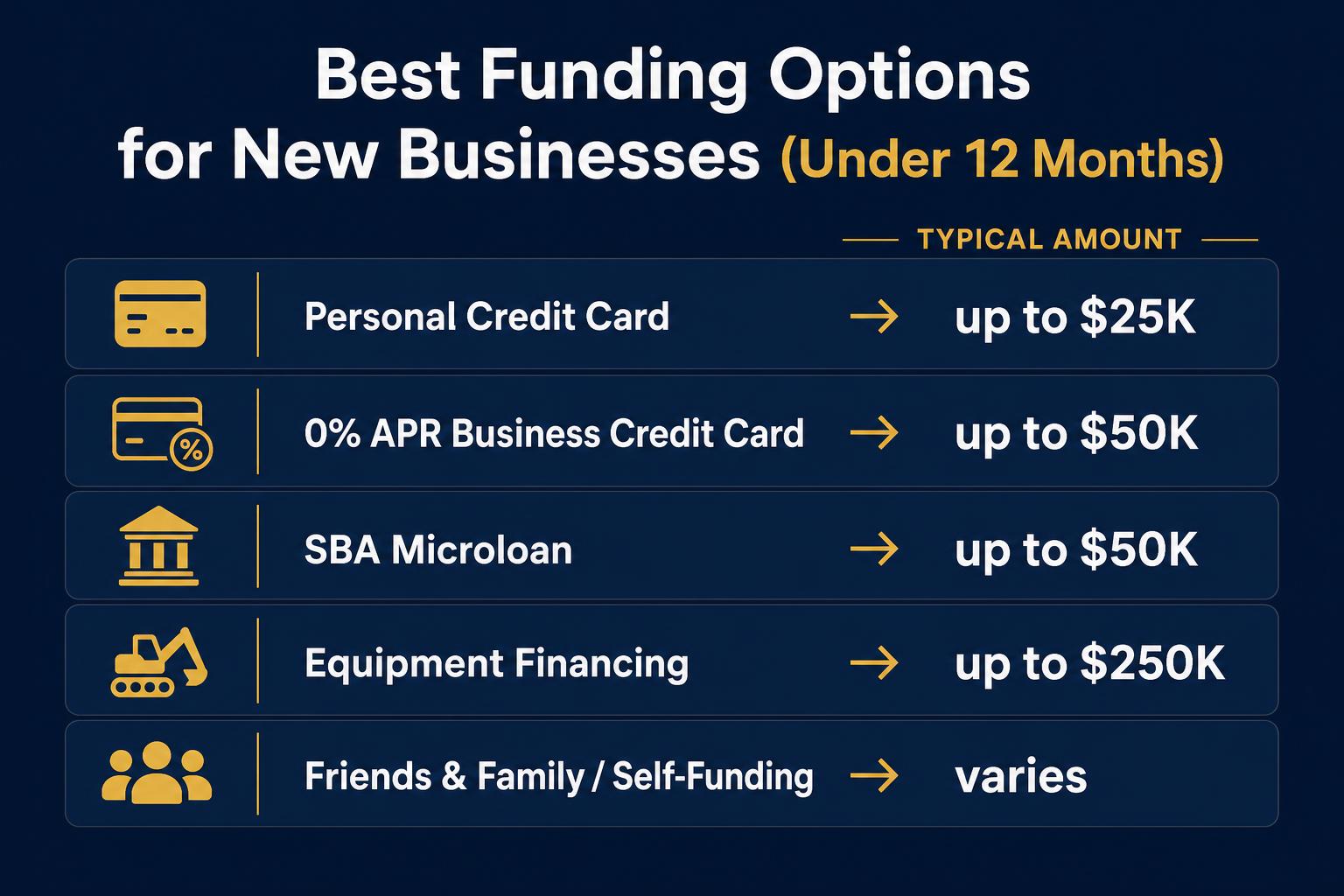
Banks and SBA generally want 2+ years. The SBA microloan program is the main early-stage exception, lending up to $50K to startups through nonprofit intermediaries, but it requires a detailed business plan, owner equity contribution, and 30–90 days to fund.
How underwriters score a new business
With limited business history, underwriters lean heavily on three things: personal FICO (often 580+ minimum, 620+ for better pricing), recent bank statements (the last 3–6 months of deposits, consistency, and absence of NSFs), and industry NAICS (some industries decline before any other factor is reviewed).
Time in business adds a multiplier: at 3 months, expect maximum 0.5x monthly revenue in loan size and 35%–55% APR equivalent. At 6 months, up to 1x monthly revenue and 25%–40% APR. At 12 months, up to 1.5x monthly revenue and 18%–32% APR. Each milestone unlocks better terms.
The biggest risk in year one: stacking
Stacking, taking a second short-term advance while a first is still active — is the most common reason year-one businesses fail financially. Each additional daily debit compounds cash-flow pressure; lenders see stacking as a major red flag and decline future applications. The safer pattern: one product at a time, with a clear 6–12 month payoff plan before adding any new debt.
If you've already stacked, the right move is consolidation or refinance, not another advance. BizBee advisors can model whether consolidation actually saves money before recommending.
What separating personal and business finances actually requires
Year-one underwriters look for four signs of clean separation: a dedicated business checking account (no commingled personal deposits), a business credit card paid from the business account, the business legally registered as an LLC or corporation (sole proprietors face additional scrutiny), and an EIN on file with the IRS. Owners who skip any of these typically see their applications routed to less competitive lenders or receive 3–8 APR points worse pricing than necessary.
Practical setup, in order: form the LLC or corporation, apply for an EIN at irs.gov (free, takes 10 minutes), open a business checking account at any bank that accepts new LLCs (Chase, Bank of America, Bluevine, Mercury all accept under-6-month businesses), apply for a business credit card under the EIN once 60–90 days of business banking history exists. This sequence usually takes 30 days end-to-end and unlocks meaningfully better year-one funding terms.
Building business credit alongside personal credit is the long game. Net-30 vendor accounts with Uline, Quill, and Grainger report to Dun & Bradstreet and can establish a PAYDEX score within 90–120 days. A PAYDEX of 80+ alongside a 680+ personal FICO is the strongest year-one borrower profile and qualifies for the lowest available pricing across the partner network.
Why personal guarantees are non-negotiable in year one, and what they actually mean
Virtually every year-one business loan requires a personal guarantee (PG) from the owner. The reason is structural: a business with under 12 months of operating history has no independent payment record, so the lender's only meaningful protection is the owner's personal credit and personal assets. A PG makes the owner personally liable for any unpaid balance if the business cannot pay. This isn't predatory, it's the price of getting financing before the business has established its own creditworthiness.
What a PG actually exposes: in default, the lender can pursue the owner's personal credit (the unpaid balance hits the personal credit report and FICO), personal bank accounts (after a judgment), and in some states personal property and wages (after additional legal steps). What a PG does not expose: retirement accounts (401k/IRA are protected by federal ERISA law in most cases) and a primary residence in homestead-protection states. Owners should know exactly which assets are at risk before signing.
Two PG mitigation strategies that work in year one: (1) Negotiate a limited PG that caps personal liability at 50%–80% of the balance rather than 100%, most lenders will agree on loans above $100K with strong personal credit. (2) Use SBA 7(a) loans above $350K where the SBA guaranty reduces the lender's exposure and PG terms are often slightly more favorable. Year-two and beyond, as the business builds its own credit, PG-free options gradually open up, but in year one, expect to sign one on every loan.
How to decide if this is right for you
Five questions decide whether and how to fund a new business.
-
1
Are you at 6+ months with $15K+/mo revenue?
Yes = mainstream working capital and MCA options are open. No = limited to MCAs at 3 months or personal-credit products.
-
2
Is the funded use revenue-generating in 60 days?
Year-one debt is too expensive to fund slow-payback uses. Confirm ROI is fast and clear.
-
3
Is there already a short-term advance active?
If yes, do not stack. Refinance or consolidate instead.
-
4
Can you wait 3–6 months for better pricing?
Each milestone (6 months, 12 months) unlocks 5%–10% APR better pricing. Don't pay year-one premiums if the need can wait.
-
5
Have you separated personal and business finances?
Clean separation improves underwriting and prevents personal damage from business issues. Set up before applying.
When this makes sense
- You have revenue and a clear use of funds, not just an idea.
- The funded use will quickly grow revenue or cut cost.
When to be careful
- Taking expensive money to plug structural losses early.
- Stacking multiple short-term advances in the first year.
How this plays out in practice
6-month-old SaaS with strong revenue
Situation: 6 months in business, $35K/mo MRR, 680 FICO, no existing debt, needs $50K to hire two engineers.
Recommendation: Working capital loan or revenue-based financing. Expect 22%–30% APR. Clear ROI on engineering hires within 90 days makes the rate workable.
3-month-old retail business
Situation: 3 months in business, $22K/mo deposits, 620 FICO, needs $20K for inventory.
Recommendation: MCA at factor 1.30–1.38 or a personal-credit business credit card. Avoid larger advances at this stage — build 3 more months of history first.
Pre-revenue startup
Situation: Pre-revenue tech startup with strong founder personal credit, needs $75K for product development.
Recommendation: SBA microloan, personal credit cards (0% intro APR), friends/family, or angel investment. Traditional small-business debt is not available pre-revenue.
9-month-old food truck looking for second location capital
Situation: 9 months in business, $28K/mo deposits, 640 FICO, one active MCA ($18K balance, $200/day debit), needs $40K to outfit a second truck.
Recommendation: Do not stack a second MCA. Pay down the existing MCA to under $5K balance over the next 60 days, then refinance into a single working-capital loan at 24%–30% APR covering both the existing balance and the new $40K need. Saves cash flow and avoids the year-one stacking spiral.
Year-one owner pitched an 'EIN-only, no credit check' loan
Situation: 8 months in business, $20K/mo deposits, 590 FICO; cold-call broker offers $75K 'EIN-only, no personal guarantee, no credit check' for a $1,500 'verification fee' wired upfront.
Recommendation: Walk away, three independent scam signals: EIN-only at year one (effectively impossible for $75K), no credit check (no real lender skips this), and an upfront fee. Report to the FTC. Pursue legitimate year-one options: MCA, working capital, or equipment financing with a personal guarantee.
See what your new business qualifies for
Soft-pull pre-qualification, no impact to your credit score.
Frequently asked
Common questions
Glossary
Terms worth knowing
- Time in business (TIB)
- Months since the business legally formed and started generating revenue. The primary milestone driving year-one product access.
- Stacking
- Taking a second short-term advance while a first is still active. Major underwriting red flag and primary cause of year-one failure.
- Loan-to-revenue cap
- The maximum loan size as a multiple of monthly revenue, typically 0.5x–1.5x depending on tier.
- Personal-credit-based business loan
- A business loan underwritten primarily on the owner's personal credit rather than business performance. Common in early-stage funding.
- PAYDEX score
- Dun & Bradstreet's 0–100 business credit score based on vendor payment history. A PAYDEX of 80+ takes about 90–120 days of on-time net-30 vendor payments to build.
- Personal guarantee (PG)
- The owner's personal commitment to repay business debt if the business cannot. Required on virtually every year-one business loan because the business has no independent payment history.
- EIN-only loan
- A business loan extended without a personal guarantee. Legitimate EIN-only financing is rare in year one, most 'EIN-only' pitches to startups are scams or shell-company schemes.
Ready to Join the Hive?
Apply now via BeeLine™ and get your funding decision in minutes. Complete in less than 60 seconds.