Startup Business Loans: Funding Options for New Ventures
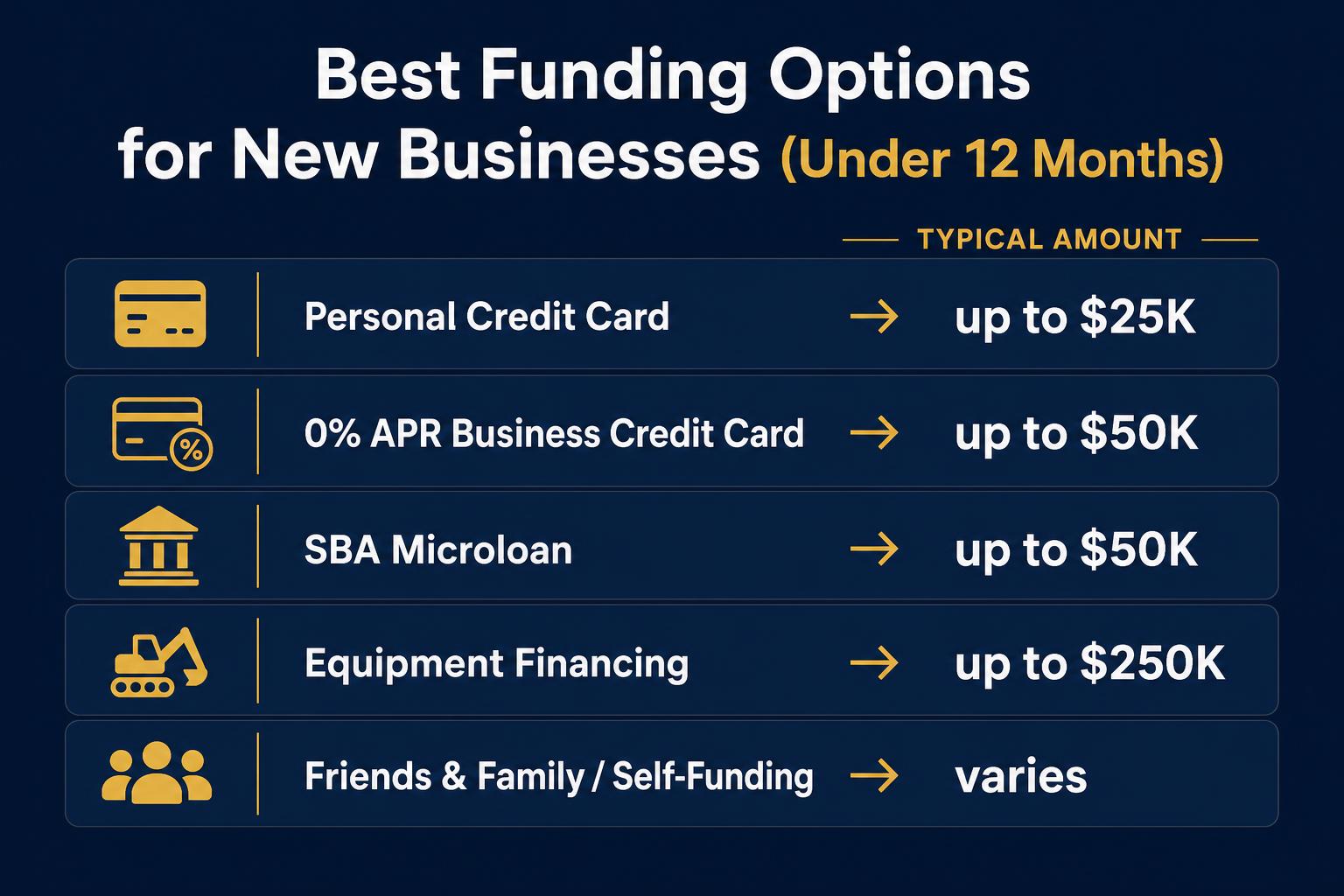
Startup business loans for new ventures fall into six realistic categories: SBA microloans (≤$50K at 8%–13% per NerdWallet), equipment financing (asset-secured, often startup-friendly), revenue-based financing (once monthly revenue exists), business credit cards, personal-credit-backed startup loans, and friends/family/grants. Most traditional bank and online term loans require 6–12 months of revenue, so true pre-revenue ventures rely on the SBA microloan, equipment, and credit-based channels.

Startup business loans are the subset of small business financing realistically available to new ventures with less than 12 months of operating history. The six realistic categories are: SBA microloans up to $50,000 (currently 8%–13% APR per NerdWallet, June 2026, administered through community lenders); equipment financing that uses the asset itself as collateral and is often available to brand-new businesses; revenue-based financing for startups already generating monthly revenue; business credit cards built on the owner's personal credit; personal-credit-backed startup loan products; and non-debt sources like friends/family, grants, and revenue-share. Traditional bank term loans and standard SBA 7(a) loans typically require 2+ years of business history, putting them out of reach for pre-revenue startups. BizBee Funding works with startup-friendly partners across the realistic channels, including equipment financing and revenue-based products that begin to open up at 3–6 months of operating history.
Key takeaways
- Six realistic startup loan channels: SBA microloan, equipment financing, revenue-based, business credit cards, personal-credit-backed, friends/family/grants.
- SBA microloans up to $50,000 at 8%–13% APR per NerdWallet (June 2026) are administered through community lenders and often startup-friendly.
- Equipment financing is one of the most accessible startup options, the asset itself secures the loan.
- Revenue-based financing typically opens at 3–6 months of monthly revenue.
- Traditional bank and standard SBA 7(a) loans require 2+ years of operating history.
- Personal credit score (typically 650+) becomes the primary qualifier for many startup products.
- True pre-revenue ventures usually rely on the SBA microloan, equipment, and personal-credit channels.
Who this is for
Founders of brand-new businesses (0–6 months) looking for the realistic capital options before they have meaningful revenue.
Operators 6–12 months in who are starting to generate monthly revenue and want to know which products are now becoming accessible.
Side-business owners considering going full-time and needing capital to bridge the transition.
What you need to qualify
Typical startup loan qualifications by channel. Pre-revenue ventures have fewer options; ventures with 6+ months of revenue see the menu widen significantly.
| Requirement | Typical standard |
|---|---|
| SBA microloan | Often startup-friendly; 640+ FICO typical; community-lender administered |
| Equipment financing | Frequently startup-eligible; asset secures the loan; 600+ FICO typical |
| Revenue-based financing | 3–6 months of revenue; $10K+ monthly deposits typical |
| Business credit cards | Personal credit driven; 650+ FICO for best terms |
| Personal-credit-backed startup loan | 680+ FICO often required; personal guarantee |
| Friends, family, grants | No credit standard; legal documentation strongly recommended |
| Bank term loan (typically off-limits) | Requires 2+ yrs in business, profitability, strong collateral |
Best funding options
The realistic startup funding products by channel. Match to your operating stage (pre-revenue vs. early revenue) for the right shortlist.
SBA Microloan
Up to $50,000 at 8%–13% APR (NerdWallet, June 2026). Administered by community development financial institutions (CDFIs). Often startup-friendly with credit counseling support.
Equipment Financing
Asset-secured loan for trucks, machinery, restaurant equipment, medical devices, and shop tools. Frequently available to brand-new businesses since the equipment itself is the collateral.
Revenue-Based Financing
Once you have 3–6 months of monthly revenue, you can borrow against future revenue with payments that flex as your sales flex. No fixed monthly burden.
Business Line of Credit (startup-friendly)
A small starter line ($10K–$50K) backed primarily by the owner's personal credit. Useful for cash flow management as the business stabilizes.
Personal-Credit-Backed Startup Loan
A startup term loan underwritten primarily on the owner's personal credit and history. Best for 680+ FICO owners with a clear business plan.
Business Credit Cards
Often the easiest first business credit instrument. Builds business credit history while providing operational flexibility for smaller purchases.
What Pre-Revenue and Early-Revenue Startups Can Realistically Borrow
The most common myth about startup business loans is that any product is realistically available to a pre-revenue venture. The truth is narrower: most traditional bank term loans, standard SBA 7(a) loans, and the majority of online term-loan products require either 2+ years of operating history, $100,000+ in annual revenue, or both. A new venture with no revenue typically cannot qualify for any of those, regardless of the founder's personal credit. The realistic pre-revenue menu is much shorter: SBA microloans, equipment financing where the asset secures the loan, personal-credit-backed startup loan products, business credit cards, and non-debt sources (friends/family, grants, revenue-share, equity).
SBA microloans up to $50,000 at 8%–13% APR per NerdWallet (June 2026) are administered through community development financial institutions (CDFIs) and often include built-in business counseling. Eligibility varies by CDFI, but many are intentionally startup-friendly and require a credible business plan more than a deep operating history. Equipment financing works because the lender's primary collateral is the asset itself — a $30,000 commercial truck or oven secures roughly $30,000 of credit risk, regardless of the borrower's business history. Personal-credit-backed startup loans treat the loan primarily as a personal underwriting decision (typically 680+ FICO required) with the business as the secondary repayment source.
Once a startup crosses 3–6 months of operating history with consistent monthly bank deposits, typically $10,000+ in monthly revenue, the menu widens. Revenue-based financing becomes available, with repayment that flexes as a percentage of monthly revenue. Smaller starter lines of credit ($10K–$50K) become accessible. Some short-term working capital products begin to consider startups in this range, though pricing remains higher than for established businesses. At 12 months of operating history with $100K+ in annual revenue and a 600+ FICO, the founder begins to see the broader online direct lending market and can start comparing across multiple product types.

How to Build a Realistic Startup Funding Plan
The strongest startups stack their funding sources sequentially rather than relying on any single product. A common and well-functioning sequence is: (1) founder capital and credit cards for the first 3–6 months of operations and equipment; (2) friends, family, and small grants for additional working capital with minimal interest cost; (3) equipment financing for major assets as the venture stabilizes, preserving cash for operating expenses; (4) SBA microloan once the venture has a clear plan and modest operating history to demonstrate viability; (5) revenue-based or short-term working capital products at 6 months once deposits are consistent; and (6) standard bank, SBA 7(a), and online term loan products at 12–24 months as the operating history becomes lendable.
Two structural mistakes consistently hurt early-stage founders. The first is taking on a daily-debit short-term advance (MCA or hard working capital) too early, before monthly revenue is consistent enough to support the debit schedule without choking cash flow. The second is funding ongoing operating losses rather than specific growth investments, debt that is repaying itself out of new losses rather than new revenue is the leading cause of startup financial distress we see.
The practical filter for a startup loan decision is the same as for any borrowing decision, but with a higher bar: the projected return on the borrowed capital should clearly and conservatively exceed the all-in cost of the loan, and the venture should have a credible plan for servicing the debt even under a 25%–30% downside revenue scenario. For a true startup, that downside scenario must include the very real possibility of taking longer than expected to reach breakeven. If the borrowing plan does not survive that scenario, borrow less, borrow differently, or wait.
What this typically costs
What $25,000 of capital typically costs across realistic startup channels. Use as benchmark when evaluating any specific startup loan offer.
| SBA microloan ($25K, 6 yrs) | 8%–13% APR · ~$5,400–$8,700 total interest |
| Equipment financing ($25K, 5 yrs) | 10%–22% APR · ~$6,900–$15,400 total interest |
| Personal-credit startup loan ($25K, 3 yrs) | 12%–35% APR · ~$4,900–$15,200 total interest |
| Revenue-based ($25K, ~12 mo) | Factor 1.20–1.35 · $5,000–$8,750 total fee |
| Business credit card balance ($25K) | 18%–29% APR if carried; 0% promo periods if available |
| Friends/family loan ($25K) | Variable; document with promissory note and interest at AFR minimum |
How to decide if this is right for you
Sequence your startup capital instead of stacking products. Use this 5-step framework.
-
1
Map your runway
Plot 18 months of projected operating expenses and revenue. Identify the cash gap and the realistic break-even date. The funding plan should bridge to break-even with a buffer, not fund losses indefinitely.
-
2
Match product to use of funds
Equipment purchases → equipment financing. Working capital and inventory → SBA microloan or revenue-based once revenue is consistent. One-time launch expenses → personal-credit-backed term loan or founder capital. Avoid MCAs for ongoing operating costs.
-
3
Stack sources sequentially
Founder capital + credit cards → friends/family/grants → equipment financing → SBA microloan → revenue-based → bank/SBA 7(a) as the venture matures. Each step requires more operating history to unlock.
-
4
Protect personal credit
Many startup products report to personal credit. Avoid maxing out personal cards or stacking multiple personal-credit-backed startup loans, this restricts your future financing options.
-
5
Re-evaluate every 3–6 months
Your channel options expand with operating history. Refinance higher-cost early debt into lower-cost later products as soon as you qualify. Many founders pay 30%–60% APR longer than necessary simply by not re-shopping the file.
When this makes sense
- When the use of funds is a specific, time-bound investment with a measurable expected return.
- When the projected cash flow supports the repayment even under a 25%–30% downside revenue scenario.
- When you have explored non-debt sources (founder capital, friends/family, grants) before adding debt.
- When you are matching product to operating stage rather than taking the first 'approval' offered.
- When the personal credit impact is understood and acceptable.
When to be careful
- When you are taking on debt to cover ongoing operating losses with no clear path to break-even.
- When the daily or weekly debit schedule will choke cash flow during normal revenue swings.
- When you are stacking startup loans on top of business credit cards on top of personal cards.
- When the lender will not work with startups but is willing to underwrite primarily against personal credit — this is functionally a personal loan in disguise.
- When you are paying MCA-level pricing on capital that could realistically be sourced from an SBA microloan or equipment financing.
How this plays out in practice
Real-world example: the food truck that started with equipment financing
Situation: A new food truck operator needed $48,000 for the truck and kitchen build-out. He had 4 months in business, $14K monthly revenue, and a 680 FICO.
Recommendation: We placed equipment financing for the truck at 12% APR over 60 months (~$1,070/mo, total interest ~$15,800). Because the truck secured the loan, the rate was significantly lower than the unsecured working capital alternatives he had been quoted (22%–35% APR). The truck depreciated predictably, the loan paid down on schedule, and at month 18 we refinanced the remaining balance into a lower-rate term loan as his operating history grew.
Real-world example: the SaaS startup that used SBA microloan + revenue-based
Situation: A B2B SaaS startup had $8K MRR at 9 months in and needed $40K for a key engineering hire and marketing.
Recommendation: We helped him secure a $25K SBA microloan at 10.5% APR over 5 years through a CDFI (~$540/mo) and a $15K revenue-based advance at a 1.22 factor over 9 months (~$1,800 in fees, repaid as % of monthly revenue). Total capital cost: ~$8,800. The SBA microloan funded the engineer (a longer-payback investment); the revenue-based funded marketing (a shorter-payback investment). Sequenced correctly.
Real-world example: the early-stage founder who took an MCA and regretted it
Situation: A 5-month-old retail startup with $9K monthly revenue took a $20K MCA at a 1.38 factor with daily ACH debits over 6 months. Daily debit: ~$230. Total payback: $27,600.
Recommendation: The daily debit exceeded the safe cash flow envelope, and the founder hit two NSFs within 90 days. We refinanced into a small SBA microloan after the operating history reached 9 months, but the early MCA cost roughly $4,500 more than equivalent equipment financing or microloan capital would have, and the NSFs delayed access to better products for several months.
Find startup-friendly funding for your new venture
Apply once with a soft credit pull and we'll match you with startup-friendly options across our network, SBA microloan partners, equipment financing, revenue-based programs, and small starter lines of credit. No upfront fees, no obligation.
Frequently asked
Common questions
Key facts in one line
- Six realistic startup loan channels: SBA microloan, equipment financing, revenue-based, business credit cards, personal-credit-backed startup loans, and friends/family/grants.
- SBA microloans up to $50,000 at 8%–13% APR per NerdWallet (June 2026) are administered through CDFIs and often startup-friendly.
- Equipment financing is one of the most accessible startup options because the asset itself secures the loan.
- Revenue-based financing typically opens at 3–6 months of consistent monthly revenue.
- Traditional bank term loans and standard SBA 7(a) loans typically require 2+ years of operating history.
- Personal credit score (typically 650+) is the primary qualifier for most startup loan products.
Glossary
Terms worth knowing
- Microloan
- A loan up to $50,000, typically administered through community development financial institutions and often startup-friendly.
- CDFI (Community Development Financial Institution)
- Mission-driven lender certified by the U.S. Treasury to provide capital in underserved markets. Administers many SBA microloans.
- Pre-revenue
- A business that has not yet generated meaningful operating revenue. Restricts available loan channels.
- Revenue-based financing
- Capital repaid as a fixed percentage of monthly revenue. Payments flex with sales.
- Personal guarantee
- A signed promise by the founder to repay business debt personally if the company cannot.
- Equipment financing
- A loan secured by the equipment being purchased; the asset serves as collateral.
- Founder capital
- Capital contributed by the founder(s) from personal savings, retirement accounts, or other sources.
- Runway
- The number of months a business can continue operating before exhausting its cash reserves.
- Break-even
- The point at which revenue covers all operating expenses and the business stops consuming cash.
Ready to Join the Hive?
Apply now via BeeLine™ and get your funding decision in minutes. Complete in less than 60 seconds.