Commercial Property Loan Calculator: Estimate Your Real Payment
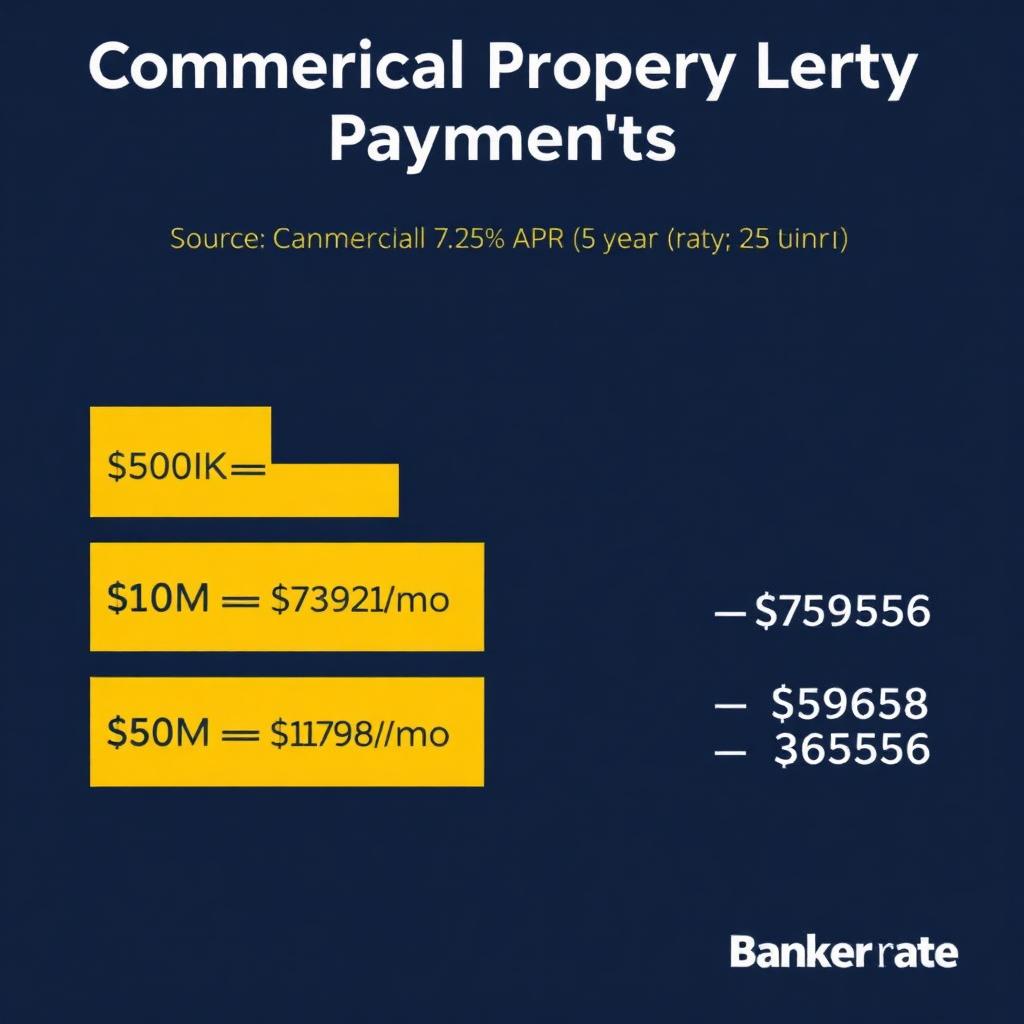
Commercial property loan payments follow standard amortization, typically at 6.5–8.5% APR over 20–25 years for conventional, or 5–7% APR for the SBA 504 CDC portion. Example payments at 7.5% APR / 25 years: $500K = $3,696/mo, $1M = $7,391/mo, $2M = $14,782/mo, $5M = $36,956/mo. Add 1–3% closing costs and 10–25% down payment for total project cost.
Commercial property loan payments follow standard amortization, typically at 6.5–8.5% APR over 20–25 years for conventional, or 5–7% APR for the SBA 504 CDC portion. Example payments at 7.5% APR / 25 years: $500K = $3,696/mo, $1M = $7,391/mo, $2M = $14,782/mo, $5M = $36,956/mo. Add 1–3% closing costs and 10–25% down payment for total project cost.
Key takeaways
- Standard commercial property amortization: 20–25 years.
- Current conventional rates: 6.5%–8.5% APR (Bankrate, 2026).
- SBA 504 CDC portion: 5–7% APR fixed at debenture sale.
- Down payment: 10% (SBA 504) to 25% (conventional bank) typical.
- $1M loan at 7.5% APR over 25 years = $7,391/mo, $1.22M interest over life.
- Many commercial loans use 5- or 10-year balloon structures requiring refinance.
- SBA 504 is often the lowest-cost option for owner-occupied real estate up to $5.5M project.
Who this is for
Small business owners researching commercial property loan calculator who want a clear, advisor-quality overview before making a financing decision.
Operators comparing a current offer against alternative commercial property loan calculator options to confirm they are getting market-competitive terms.
First-time borrowers who want to understand the full commercial property loan calculator landscape before applying.
What you need to qualify
Typical requirements across the BizBee Funding partner network. Specific minimums vary by lender and product.
| Requirement | Typical standard |
|---|---|
| Property type | Owner-occupied preferred for SBA; investment available conventional |
| Personal FICO | 680+ typical (650+ for SBA, 700+ for best conventional pricing) |
| Time in business | 24+ months typical |
| DSCR | 1.20+ typical (1.25+ preferred) |
| Down payment | 10% (SBA 504), 10–15% (SBA 7(a) RE), 20–30% (conventional) |
| Personal guarantee | Required for all 20%+ owners |
Best funding options
Product categories available through BizBee's lender network for this topic.
SBA 504 Loan
Best for owner-occupied real estate up to $5.5M project. 10% down, lowest blended rate.
SBA 7(a) Loan
Up to $5M. More flexible use, 25-year amortization for real estate.
Conventional Bank Real Estate
Investment properties; 20–30% down; market rates.
Bridge Loan
Short-term capital while waiting for permanent financing.
Expansion Funding
Combine real estate with equipment and working capital.
How Commercial Property Loan Math Actually Works
Commercial property loans use the same amortization formula as residential mortgages, but with several structural differences. Most commercial loans amortize over 20–25 years but mature at 5, 7, or 10 years — meaning the loan is calculated as if it will be paid over 25 years, but the entire remaining balance comes due as a balloon payment at the maturity date. You either refinance, pay off, or sell at that point.
Conventional commercial property rates in 2026 range 6.5–8.5% APR per Bankrate, depending on property type, loan-to-value (LTV), borrower credit, and debt-service-coverage ratio (DSCR). Owner-occupied properties typically price lower than investment properties. Multi-tenant office and retail in stable markets price favorably; specialty-use properties (restaurants, gas stations, churches) often price higher.
SBA 504 loans are the standout product for owner-occupied commercial real estate up to $5.5M project size. The structure: 50% bank loan at conventional rate, 40% CDC loan at 5–7% APR fixed for 20–25 years, and 10% borrower equity. The CDC portion's low fixed rate and long amortization typically save 1.5–3% on the blended effective rate compared to a 100% conventional loan.
SBA 7(a) can also fund real estate, with amortization up to 25 years if the property is the primary use of funds. Current 7(a) rates are 9.75–14.75% per NerdWallet (June 2026) — higher than 504, but 7(a) has more flexibility on use of funds and faster closing for some borrowers.
Down payment requirements vary by program: SBA 504 requires 10% borrower equity (15–20% for special-purpose properties). SBA 7(a) real estate typically requires 10–15%. Conventional bank loans typically require 20–30%. Bridge and private lenders may go higher LTV but at substantially higher rates.
Closing costs on commercial property loans run 1–3% of loan amount and include: appraisal (typically $3K–$15K for commercial), Phase I environmental ($2K–$8K), title insurance, recording fees, legal review, SBA guaranty fee (on SBA loans), and bank/CDC origination. Budget 2–4% of loan amount as a safe planning number.
Worked example for a $1M owner-occupied retail property purchase using SBA 504: $1M project = $500K bank loan + $400K CDC loan + $100K borrower equity. Bank portion at 7.75% over 25 years = $3,786/mo. CDC portion at 6.5% over 25 years = $2,701/mo. Total monthly debt service = $6,487 vs. $7,391 if 100% conventional at 7.5%. SBA 504 saves $904/month, $10,848/year, $271,200 over 25 years.
What this typically costs
Representative 2026 cost scenarios. Your actual offer depends on credit, revenue, time in business, and lender.
| $500K / 25 yr / 7.5% APR conventional | $3,696/mo · $1.109M total · $609K interest |
| $500K SBA 504 blended ~6.75% | $3,464/mo · $1.039M total · $539K interest |
| $1M / 25 yr / 7.5% APR conventional | $7,391/mo · $2.217M total · $1.217M interest |
| $1M SBA 504 blended ~6.75% | $6,927/mo · $2.078M total · $1.078M interest |
| $2M / 25 yr / 7.5% APR conventional | $14,782/mo · $4.434M total · $2.434M interest |
| $5M / 25 yr / 7.5% APR conventional | $36,956/mo · $11.087M total · $6.087M interest |
| Closing costs | Add 2–4% of loan amount (appraisal, environmental, title, legal) |
How to decide if this is right for you
Use this 5-step framework to narrow your shortlist before comparing specific offers.
-
1
Run the SBA 504 comparison first
For owner-occupied real estate, 504 is almost always the lowest blended cost. Always run the comparison before defaulting to conventional.
-
2
Use mid-range rate for initial estimate
7.5% APR / 25 years is a reasonable conventional planning estimate in 2026. Adjust as actual quotes come in.
-
3
Add 2–4% closing costs to your equity plan
Closing costs aren't financed; they come from your equity. Plan for the high end of the range.
-
4
Model the balloon maturity 12–24 months early
If your loan has a 5- or 7-year balloon, plan refinance well ahead of maturity to avoid rate-spike risk.
-
5
Stress test DSCR at 20% revenue dip
Real estate loans are long-duration commitments. Confirm cash flow covers debt service in a downturn scenario.
When this makes sense
- You're purchasing owner-occupied commercial real estate for your business.
- You're refinancing an existing commercial mortgage at a lower rate or to extract equity.
- You're estimating affordability for a real estate expansion.
- You're comparing SBA 504 vs. conventional vs. 7(a) for a specific project.
- You're stress-testing a balloon-payment scenario against your refinance options at maturity.
When to be careful
- When you've ignored the balloon maturity in your projections (most commercial loans aren't 25-year fully amortizing).
- When closing costs aren't built into the down-payment planning.
- When you've used residential mortgage assumptions for a commercial property (very different structure).
- When DSCR projections rely on best-case tenant assumptions for investment properties.
- When you haven't compared SBA 504 vs. conventional for owner-occupied real estate (the savings are often substantial).
How this plays out in practice
SBA 504 saves six figures
Situation: Manufacturer wanted to buy its $1.4M facility plus $300K of equipment. 5 years in business, FICO 715.
Recommendation: SBA 504 structure: $850K bank loan at 7.5% / 25 yr ($6,283/mo) + $680K CDC loan at 6.25% / 25 yr ($4,486/mo) + $170K equity. Total monthly $10,769. Conventional 25-year mortgage at 8.5% would have been $14,109/mo. Savings: $3,340/mo, $40,080/year, $1.002M over 25 years.
The balloon refinance plan that wasn't
Situation: Owner financed $850K at 7% APR / 25-year amort / 7-year balloon. At year 7, market rates were at 9.5% and property values had softened.
Recommendation: Locked in a refinance 18 months before maturity to avoid the rate spike — accepted a small prepayment penalty on the original loan to capture a better rate environment. Always plan refinance 12–24 months ahead of balloon maturity, not at the last minute.
Closing costs nearly killed the deal
Situation: Owner budgeted $50K cash for closing on a $500K SBA 504 deal but actual costs came to $78K (Phase I environmental, appraisal, legal review on a complex title).
Recommendation: Bridged the $28K gap with a short-term working capital loan and closed on schedule. Lesson: budget closing costs at 4% of loan amount as a safe planning number, not the 2% rule-of-thumb.
Compare SBA 504 vs. conventional financing for your property
Get matched with SBA-preferred CDCs, banks, and conventional lenders. Soft credit pull plus a true blended-rate comparison. Plain English.
Frequently asked
Common questions
Key facts in one line
- Commercial property loan payments at 7.5% APR over 25 years = roughly $7.40/month per $1,000 borrowed.
- SBA 504 CDC portion currently prices 5–7% APR fixed for 20–25 years.
- Owner-occupied real estate via SBA 504 often saves 1.5–3% on the blended rate vs. 100% conventional.
- Closing costs on commercial property loans run 2–4% of loan amount.
- Most commercial loans amortize over 25 years but mature at a 5–10 year balloon — plan refinance accordingly.
Glossary
Terms worth knowing
- Balloon payment
- A large final payment due at the maturity of a loan that hasn't fully amortized over the loan term. Common in commercial real estate.
- DSCR (commercial real estate)
- Net operating income (NOI) divided by total annual debt service. Most commercial lenders require DSCR of 1.20–1.25+.
- LTV
- Loan-to-Value — the loan amount divided by the property's appraised value. Lower LTV typically gets better pricing.
- Phase I environmental
- A standard environmental due-diligence report required on most commercial property purchases. Costs $2K–$8K.
Ready to Join the Hive?
Apply now via BeeLine™ and get your funding decision in minutes. Complete in less than 60 seconds.